

For most commercial air travelers, the landing phase of a flight is simply a routine signal that it's time to pack up personal belongings, turn off flight mode, and prepare for deplaning. However, for aviation enthusiasts, adrenaline seekers, and seasoned globetrotters, a dramatic airport approach can be the absolute highlight of an entire journey. Across the globe, unique topographies – ranging from sharp alpine peaks and cliffside island runways to tide-swept sandbars – force pilots to execute extraordinary tactical maneuvers that leave passengers clutching their armrests in sheer awe. Securing an effortless journey begins long before takeoff, and starting your trip with inexpensive airport parking ensures that your travel budget remains focused on unforgettable adventures rather than exorbitant garage fees. When you secure your airport reservation ahead of time through AirportParking.deals, you set the stage for a seamless, stress-free departure, allowing you to fully focus on the heart-pounding spectacle waiting outside your airplane window.
Are You Brave Enough to Land at the World's Most Extreme Airports?
1. Innsbruck Airport (INN), Austria
.jpg) Source: Google Search
Source: Google Search
Nestled deep within the Austrian Alps, Innsbruck Airport presents one of the most technically demanding arrivals in European commercial aviation. Classified as a Category C airport by European civil aviation authorities, Innsbruck requires captains – first officers aren't permitted to execute landings here – to undergo rigorous simulator training and complete real-world observation flights from the jump seat before taking the controls.
The approach path requires navigating the narrow Inn Valley, flanked by massive 8,000-foot alpine peaks that severely restrict maneuverability and compromise radar coverage. Flight crews must execute sharp, precise S-turns through the valley while battling powerful föhn winds – warm, dry down-slope winds that generate sudden, severe turbulence and microbursts. During winter months, heavy snowfall and low cloud bases reduce visibility, making visual reference points critical. Passengers seated on the left side of the aircraft are treated to stunning, close-up vistas of snow-capped peaks and traditional Alpine villages, making this white-knuckle descent as visually mesmerizing as it is pilot-demanding.
2. Cristiano Ronaldo Madeira Airport (FNC), Portugal
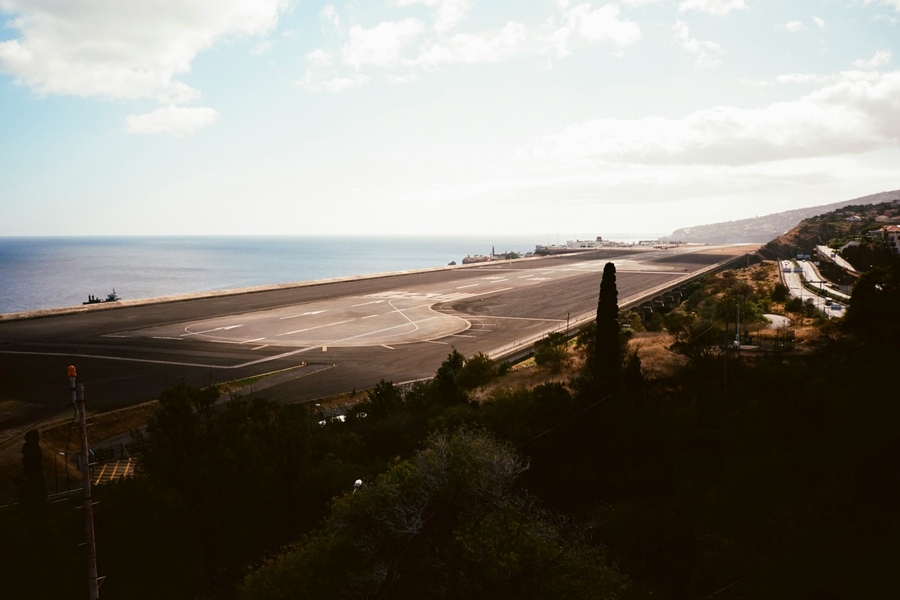
Source: Julian Guttzeit/Unsplash
Rising dramatically out of the North Atlantic Ocean, the volcanic island of Madeira offers virtually no natural flat terrain. To accommodate modern commercial jetliners, engineers executed a brilliant feat of civil engineering by expanding Madeira Airport's runway atop a massive elevated bridge structure supported by 180 soaring concrete pillars.
This artificial platform extends directly over the ocean waves, but the engineering marvel doesn't eliminate the severe atmospheric challenges surrounding the island. Positioned between high volcanic mountains and the open ocean, the airfield experiences extreme wind shear, thermal downdrafts, and unpredictable gusts. Pilots cannot execute a standard straight-in instrument approach; instead, they must fly toward the island's mountainous cliffs, execute a sharp right-hand banking turn at low altitude, and manually align with the runway moments before touchdown. Passengers experience a thrilling lateral sweep over churning ocean waters before the tires meet the asphalt.
3. Tenzing-Hillary Airport (LUK), Lukla, Nepal
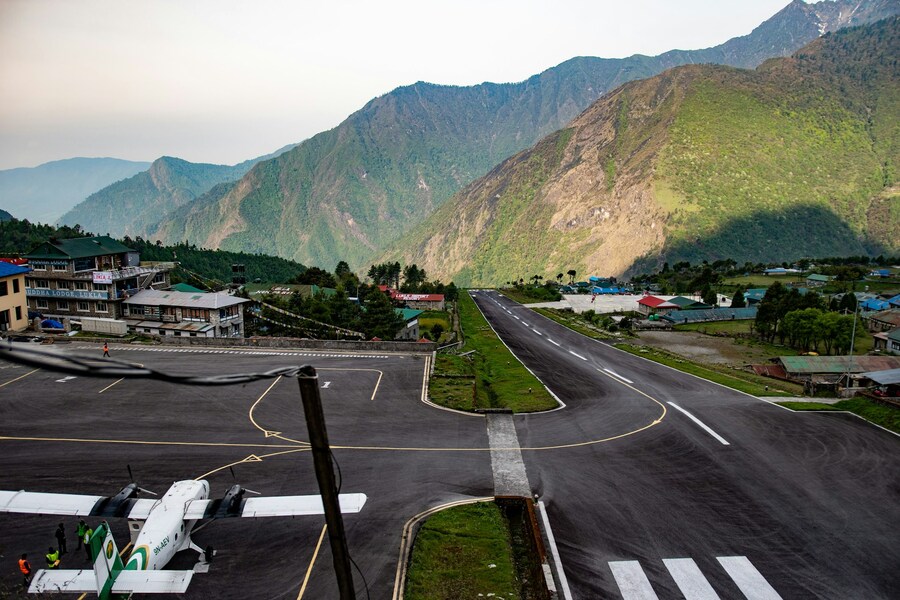 Source: Rajan Dahal/Unsplash
Perched at an astonishing elevation of 9,334 feet above sea level, Lukla Airport in Nepal is widely regarded as one of the most perilous airfields on Earth. Serving as the primary launchpad for trekkers heading to Everest Base Camp, this high-altitude airstrip features a single short runway measuring just 1,729 feet in length.
To assist incoming aircraft with deceleration, the asphalt is built on an extreme 12% upward gradient. The local geography leaves zero margin for error: at one end of the runway sits an abyss dropping into the Dudh Kosi River valley, while the opposite end terminates directly into a solid rock mountain wall. Because of the surrounding Himalayan terrain, there's no option for a go-around once an aircraft commits to its final descent past the decision point. Unpredictable alpine weather, rapid cloud cover, and shifting mountain crosswinds mean flights are almost exclusively restricted to early morning hours under Visual Flight Rules (VFR). Passengers aboard the small twin-engine turboprops experience an unforgettable rush as the aircraft squeezes through mountain gaps to land on a high mountain ledge.
4. Paro Airport (PBH), Bhutan
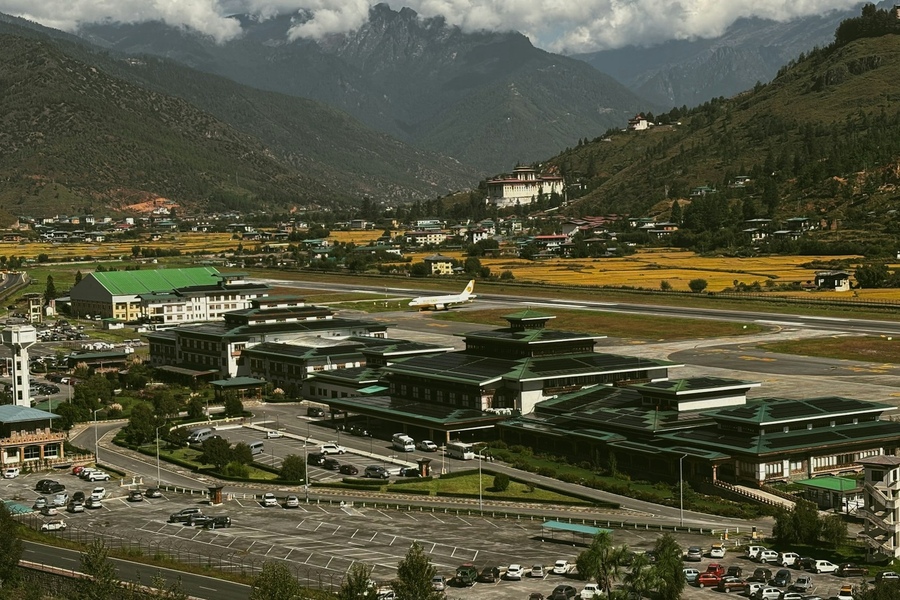 Source: Rama Krushna Behera/Unsplash
Surrounded by jagged 18,000-foot Himalayan peaks, Paro Airport is the sole international gateway to the secluded Kingdom of Bhutan. Landing here is so challenging that only a handpicked elite group of certified airline captains are licensed to perform the approach.
Aircraft must weave through narrow mountain valleys, passing dangerously close to timbered hillside homes and pine forests before executing a sudden 45-degree bank to align with the valley floor runway. Because instrument-guided landings are impossible due to terrain interference, pilots operate under strict Visual Flight Rules and can only land during clear daylight hours. Passengers flying into Paro from hubs like Delhi or Kathmandu are rewarded with stunning views of Mount Everest and Kanchenjunga from the left side of the cabin. The sensory contrast between the peaceful, serene Himalayan landscape and the intense, high-precision piloting required makes Paro one of the most magnificent aviation experiences on the planet.
5. Barra Airport (BRR), Scotland
.jpg) Source: Google Search
Source: Google Search
In the Outer Hebrides of Scotland, the island of Barra offers an approach that replaces high mountain crags with ocean waves. Barra Airport is the only commercial airport in the world where scheduled flights land directly on a broad sand beach at Traigh Mhòr.
The airport features three runways arranged in a triangle, marked out by wooden poles stuck in the sand – allowing Twin Otter aircraft to always land into the prevailing wind. However, flight schedules at Barra aren't set by fixed airline timetables; they are strictly dictated by the ebb and flow of the Atlantic tides. At high tide, the runways disappear entirely under several feet of salt water. Pilots must evaluate water depth, sand firmness, and surface debris prior to touching down. For passengers, sweeping in over turbulent ocean waters and splashing through shallow foam onto a firm shell beach provides a uniquely cinematic landing experience unlike anywhere else on Earth.
6. Wellington International Airport (WLG), New Zealand
.jpg) Source: Google Search
Source: Google Search
New Zealand's capital city, affectionately known as "Windy Welly," is famous for its relentless, howling gales. Wellington International Airport sits directly adjacent to the Cook Strait – the narrow ocean channel separating the North and South Islands.
This geographical gap acts as a natural Venturi tube, squeezing and accelerating oceanic winds across the airfield. Incoming aircraft are routinely buffeted by severe turbulence, rapid gusts, and sudden wind shear as they descend toward a single 6,827-foot runway flanked by ocean water at both ends. Flight crews must execute advanced crab landings – angling the nose of the aircraft directly into the wind while maintaining a straight track down the runway centerline – before kicking the rudder straight right at touchdown. Passengers often experience roller-coaster-like drops and lateral swaying during final approach, offering an exhilarating welcome to New Zealand's cultural capital.
7. Telluride Regional Airport (TEX), Colorado, USA
.jpg) Source: Google Search
Source: Google Search
Sitting on a high-altitude mesa at 9,070 feet above sea level, Telluride Regional Airport holds the title of the highest commercial airport in the United States. Surrounded by 14,000-foot peaks of the San Juan Mountains, the airport's single runway is carved directly into the top of a flat mountain plateau.
The primary hazard at Telluride is the vertical geography: at both ends of the runway, the ground drops off precipitously into a 1,000-foot gorge carved by the San Miguel River. During winter months, intense mountain wave turbulence and vertical downdrafts created by wind spilling off the cliffs make the final approach exceptionally tricky. Flight crews must carefully manage air density altitude, airspeed, and descent angles to ensure the aircraft settles firmly onto the runway without floating toward the cliff edge.
"Nothing you want to do tomorrow is worth risking your life and the lives of your passengers today!"
– Telluride Regional Airport Official Safety Briefing
For travelers heading to Telluride's world-class ski slopes, the arrival offers breathtaking views of pristine wilderness coupled with heart-stopping elevation changes.
8. Princess Juliana International Airport (SXM), St. Maarten
.jpg) Source: Google Search
Source: Google Search
Few aviation scenes are as globally iconic as the approach into Princess Juliana International Airport on the Caribbean island of Saint Maarten. Because Runway 10 is relatively short at 7,549 feet and directly abuts the coastline, incoming wide-body jets must cross over Maho Beach at an altitude of less than 100 feet.
Thrill-seeking tourists gather on the beach directly under the flight path to feel the warm ocean breeze pushed by landing aircraft and capture famous close-up photographs. Inside the aircraft, passengers get the surreal sensation that the plane is about to touch down directly on the turquoise Caribbean water or the sunbeaten sand before smoothly rolling onto the asphalt. The dramatic contrast between tropical relaxation and powerful jet machinery makes Saint Maarten a bucket-list journey for travel enthusiasts across the world.
Practical Travel Logistics: Elevating Your Journey from Start to Finish
Experiencing spectacular airport approaches requires smart planning both in the sky and on the ground. Researching the average price for parking early allows you to protect your travel budget for unforgettable local adventures.
With AirportParking.deals, securing reliable, inexpensive airport parking is effortless. By locking in an airport reservation ahead of time through our reservation system, you guarantee a reserved spot near your terminal at a fraction of standard drive-up rates. This simple step eliminates pre-flight stress, leaving you free to select the best window seat, plan connection buffers, and prepare for an extraordinary landing experience.
Conclusion
From the sheer alpine heights of Nepal and Colorado to the wind-swept Atlantic tides of Scotland and Madeira, the world's most spectacular airport approaches showcase the incredible harmony of human engineering, pilot skill, and modern aviation. Touching down in these legendary locations offers travel memories that last a lifetime, proving that the journey itself can be just as thrilling as the destination.
Smart travel begins long before your plane leaves the runway. By eliminating pre-flight stress and securing inexpensive airport parking, you protect both your travel budget and your peace of mind. Let AirportParking.deals handle your ground logistics – visit our reservation system today to compare options, lock in guaranteed spaces, and enjoy a flawless start to your next great journey!


